Proactive Risk Reduction
Earlier warning lead times enabling timely protective actions and reducing flood-related losses.
Building Flood Resilience Through Anticipatory Action and Public-Private Partnership
KREWS is a multi-hazard early warning initiative designed to strengthen flood preparedness and resilience across the Kabul River Basin in Khyber Pakhtunkhwa. Through a partnership between PDMA KP, WeatherWalay, and BaKhabar Kissan, the project combines real-time monitoring, predictive analytics, and community-centered dissemination to enable timely, evidence-based action before disasters occur.
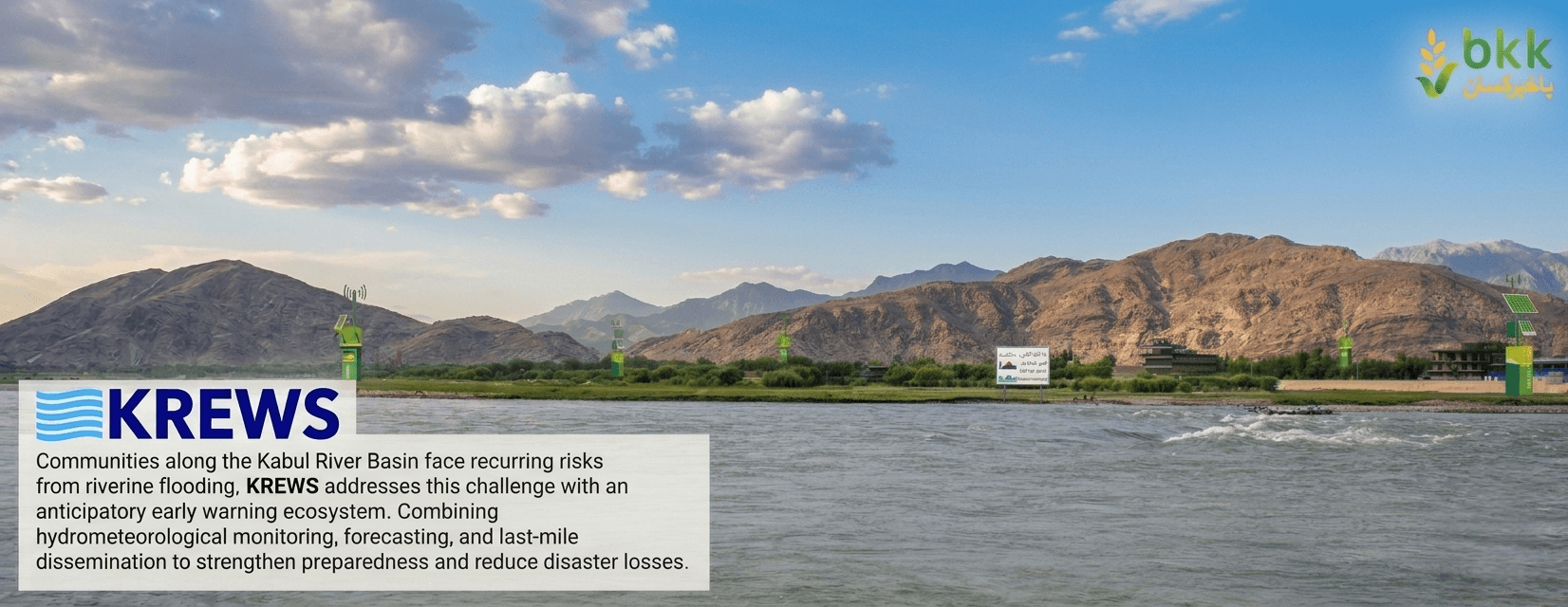
Communities along the Kabul River Basin face recurring risks from riverine flooding, extreme rainfall events, and climate variability. These hazards continue to threaten lives, livelihoods, infrastructure, and economic development across Khyber Pakhtunkhwa.
Traditional disaster management approaches often focus on response after impacts occur. KREWS addresses this challenge by establishing an anticipatory early warning ecosystem that enables government institutions and communities to act before flood impacts materialize.
The project combines hydrometeorological monitoring, forecasting intelligence, risk assessment, and last-mile dissemination to strengthen preparedness and reduce disaster losses.
To establish an integrated flood early warning system that delivers timely, actionable, and reliable risk information to government authorities and at-risk communities through real-time monitoring, predictive analytics, and multi-channel communication mechanisms.
The project seeks to strengthen anticipatory action and support a transition from reactive disaster response toward proactive risk management.
Earlier warning lead times enabling timely protective actions and reducing flood-related losses.
Strengthened capacities of local authorities, emergency responders, and communities to understand and act upon warning information.
Access to real-time information and predictive insights for evidence-based emergency management.
Greater awareness, preparedness, and adaptive capacity among vulnerable populations.
Improved coordination between disaster management authorities, technical partners, and local stakeholders.
KREWS is designed to remain operational beyond the project lifecycle through institutional ownership, capacity development, and integration within existing disaster management structures.
The project strengthens local technical capacities while establishing operational procedures and governance mechanisms necessary for long-term sustainability and future expansion.
Lessons learned from KREWS will contribute to the development of scalable early warning models for other climate-vulnerable regions of Pakistan.
KREWS demonstrates how climate adaptation, disaster risk reduction, and digital innovation can be combined to protect vulnerable populations through anticipatory action.
By linking science, technology, governance, and community engagement, the project provides a replicable model for strengthening resilience and advancing Pakistan's commitment to risk-informed development.
The project "Kabul River Early Warning System (KREWS)" is funded by the German Federal Ministry for Economic Cooperation and Development (BMZ) and supported by the Deutsche Gesellschaft für Internationale Zusammenarbeit (GIZ) GmbH through its initiative "Supporting the Implementation of the National Adaptation Plan (NAP) in Pakistan." The project is implemented by PDMA Khyber Pakhtunkhwa, WeatherWalay Pvt. Ltd., and BaKhabar Kissan Pvt. Ltd. under the NAP Challenge Fund.

Welcome to Bakhabar Community!
Connect with fellow farmers, share your crop challenges through pictures and videos, and receive personalized advice from our Agri Experts. Download our app to get real-time support and grow smarter together!
Join the community for FREE!